How to repair a microwave that is not heating:Why is my microwave running but not heating food?
Q: Why is my microwave running but not heating food?
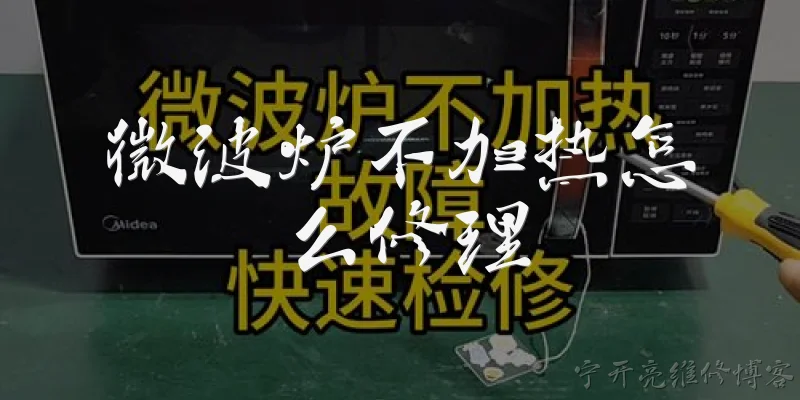
A: When a microwave runs but doesn't heat, the most common culprits are the high-voltage diode, magnetron, or capacitor. The magnetron generates the microwaves, so if it fails, no heat is produced. The high-voltage diode rectifies the voltage for the magnetron, and a shorted diode can blow the fuse or stop heating. The capacitor stores high voltage and can also fail. Less common causes include a faulty door switch or control board. Since these components involve lethal voltages, always unplug the microwave and discharge the capacitor before testing. If you're not experienced with electronics, call a professional.
Q: How do I safely discharge a microwave capacitor before repairing?
A: Before repairing any microwave, unplug it and wait a few minutes. The high-voltage capacitor can hold a dangerous charge even when unplugged. To discharge it, use an insulated screwdriver with a well-insulated handle. Connect a wire from the screwdriver shaft to the microwave chassis. Then carefully touch the screwdriver tip to the capacitor terminals (one at a time) to bleed off the voltage. You may see a spark. Repeat for both terminals. Alternatively, use a 10kΩ 10W resistor across terminals. Always wear rubber gloves and safety glasses. Never assume the capacitor is discharged—always verify with a multimeter.
Q: How can I test if the high-voltage diode in my microwave is bad?
A: To test the high-voltage diode, first unplug the microwave and discharge the capacitor. Remove the diode, which is usually connected between the capacitor and the chassis or transformer. Set your multimeter to the highest resistance range (e.g., 200kΩ or diode test). A good diode should show continuity in one direction and infinite resistance in the other. However, many microwave diodes are special high-voltage types that may not test reliably with a standard multimeter. If you get continuity in both directions, it's definitely shorted and needs replacement. If in doubt, replace it—they're inexpensive. Never test while powered.
Q: What are the symptoms of a bad magnetron in a microwave?
A: A failing magnetron often causes the microwave to run but not heat. Other signs include a loud humming or buzzing noise, burning smell, or the microwave blowing fuses. You might also see arcing or sparks inside the cavity. To test, discharge the capacitor and check the magnetron's filament for continuity (should read a few ohms). Also inspect for physical damage like burnt antenna or cracked magnet. If the filament is open or shorted, replace the magnetron. Note that magnetrons contain beryllium oxide, a toxic ceramic—handle with care and avoid inhaling dust. Replacement is usually cost-effective if the rest of the microwave is in good shape.
Q: Can a faulty door switch cause a microwave not to heat?
A: Yes, a faulty door switch can prevent heating. Microwaves have multiple interlock switches that ensure the magnetron only operates when the door is securely closed. If a switch fails, the microwave may run (fan and turntable) but not generate heat, or it may not run at all. Symptoms include intermittent heating or blowing the fuse. To test, unplug the microwave and access the switches behind the control panel. Use a multimeter to check continuity in both door open and closed positions. Replace any switch that doesn't behave correctly. Always replace switches in sets if they show wear. Safety first—never bypass door switches.
Dialogue about
Common scenarios of "How to repair a microwave that is not heating"
【User】 Hi, I'm having trouble with my microwave. It runs but doesn't heat the food. Can you help me fix it?
【Assistant】 Of course! I can help you troubleshoot. First, let's check some basic things. Is the microwave plugged into a working outlet? Does the display and turntable work?
【User】 Yes, the display works, the turntable spins, and the light comes on. But the food stays cold.
【Assistant】 That suggests the issue is likely with the high-voltage components. The most common culprits are the magnetron, diode, capacitor, or transformer. Do you have a multimeter and some basic tools?
【User】 I have a multimeter and screwdrivers. But I'm not sure how to test those parts safely.
【Assistant】 Safety first: microwaves can store lethal voltage even when unplugged. You must discharge the capacitor before testing. Do you know how to do that?
【User】 No, I don't. Can you explain how to discharge it safely?
【Assistant】 Absolutely. Unplug the microwave and wait a few minutes. Then, using an insulated screwdriver with a rubber handle, short the capacitor terminals together. But be extremely careful. Alternatively, you can use a resistor to discharge it slowly. If you're not comfortable, please call a professional.
【User】 I think I can do that. After discharging, how do I test the diode?
【Assistant】 Set your multimeter to the highest resistance setting. Test the diode in both directions. It should show continuity in one direction and infinite resistance in the other. If it shows continuity both ways or none, it's faulty.
【User】 Okay, I'll test the diode. What about the magnetron? How can I tell if it's bad?
【Assistant】 The magnetron is harder to test without specialized equipment. You can check for continuity between the filament terminals, which should read a few ohms. Also, inspect for any burn marks or damage. If the filament is open, it's bad.
【User】 I see. And the capacitor? How do I test that?
【Assistant】 With the capacitor discharged, set your multimeter to capacitance mode if available. Otherwise, use resistance mode: it should show a brief resistance then go to infinite as it charges. If it stays at zero or infinite, it's likely bad. Also, check for bulging or leaks.
【User】 What about the transformer? Any way to test it?
【Assistant】 You can test the transformer windings for continuity. The primary should have low resistance, the secondary higher, and the filament winding very low. If any winding is open, the transformer is faulty. But be careful: high voltage can still be present.
【User】 Okay, I'll test these components. If I find a faulty one, can I replace it myself?
【Assistant】 Yes, if you're handy and follow safety precautions. But make sure to buy the exact replacement part. Also, after replacing, test the microwave with a cup of water to see if it heats.
【User】 Thanks! I'll start by discharging the capacitor and testing the diode and capacitor. If I need more help, I'll ask.
【Assistant】 You're welcome. Remember, if you're unsure at any point, it's best to call a professional. Stay safe!