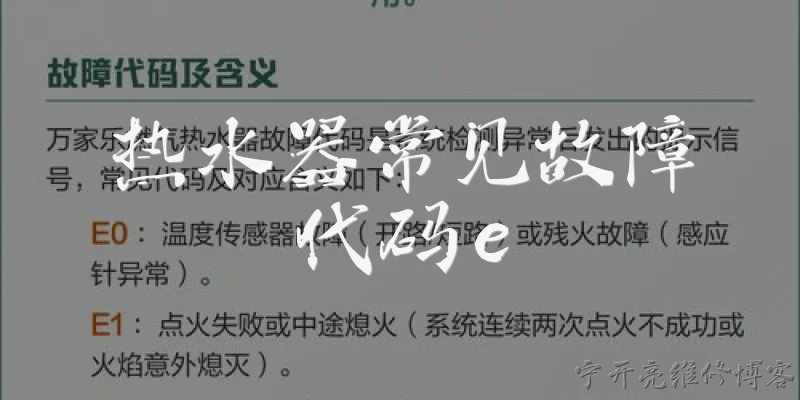
Common water heater error code E:What does error code E mean on a common water heater?
Q: What does error code E mean on a common water heater?
A: On most common water heaters, error code E typically indicates an ignition failure or flame detection problem. This means the control board attempted to light the burner but did not receive a signal that a flame was established. Possible causes include a faulty igniter, dirty flame sensor, low gas pressure, or a closed gas valve. Some models may use E with a number (e.g., E1, E2) to specify the exact issue, but a standalone E usually points to ignition or flame sensing faults. Always consult your specific model's manual for precise definitions.
Q: How can I troubleshoot a water heater showing error code E?
A: To troubleshoot error code E, first turn off power and gas. Check that the gas supply valve is fully open and that other gas appliances work. Inspect the igniter and flame sensor for dirt or damage; clean them gently with fine sandpaper. Ensure the air intake and exhaust vents are not blocked. If the igniter glows but no flame appears, the gas valve or control board may be faulty. If the flame lights but goes out, the flame sensor could be misaligned. After cleaning, reset the heater and retry. If the code persists, call a qualified technician.
Q: What are the common causes of error code E on a water heater?
A: Common causes of error code E include a dirty or faulty flame sensor, a worn-out igniter, low gas pressure or a closed gas valve, blocked combustion air intake or exhaust vent, and a defective control board. Moisture or condensation on the flame sensor can also trigger it. In some cases, a spider web or debris inside the burner assembly disrupts ignition. Additionally, a power surge or wiring issue may cause the control board to misread the flame signal. Regular maintenance, such as annual cleaning of the burner and sensor, can prevent many of these issues.
Q: Is error code E on a water heater dangerous?
A: Error code E itself is not immediately dangerous, but it indicates a failure to ignite or detect flame, which means the water heater is not heating water. The real danger arises if you repeatedly try to reset the heater without fixing the underlying issue, potentially leading to gas buildup. If you smell gas, leave the area immediately and call for help. Most water heaters have safety features that shut off gas after a failed ignition attempt, so the risk is low. However, ignoring the code can lead to carbon monoxide production if incomplete combustion occurs. Always prioritize safety and seek professional help if unsure.
Q: Can I reset my water heater to clear error code E, and how?
A: Yes, you can often reset the water heater to clear error code E. First, turn off the power at the circuit breaker and turn off the gas supply. Wait 5 to 10 minutes to allow any residual gas to dissipate. Then restore power and gas, and press the reset button on the control panel if available. Some models require holding the reset button for a few seconds. If the code returns immediately or after a short time, the underlying issue persists. Do not repeatedly reset without addressing the cause, as this can be hazardous. Refer to your manual for the exact reset procedure.
Words of experience
Common scenarios of "Common water heater error code E"
【User】 Hi, my water heater is showing error code E. What does that mean?
【Technician】 Error code E on a water heater typically indicates a problem with the ignition system or flame sensor. It means the heater is trying to ignite but can't detect a flame.
【User】 Is it safe to keep trying to use it?
【Technician】 No, it's not safe. If the heater can't ignite, gas might be accumulating. Turn off the power and gas supply immediately and call a professional.
【User】 Okay, I've turned everything off. What could cause this error?
【Technician】 Common causes include a dirty flame sensor, faulty igniter, gas supply issues, or a clogged burner. It could also be a problem with the control board.
【User】 Can I try to clean the flame sensor myself?
【Technician】 If you're comfortable with DIY, you can gently clean the flame sensor with fine sandpaper or steel wool. But make sure the power and gas are off first.
【User】 I'll try that. How do I access the flame sensor?
【Technician】 It depends on your model. Usually, you need to remove the access panel. The flame sensor is a small rod near the burner. Consult your manual for exact location.
【User】 I cleaned it but the error persists. What now?
【Technician】 Then it might be a faulty igniter or gas valve. I recommend calling a licensed technician to diagnose further. Don't attempt to replace gas components yourself.
【User】 How much does a typical repair cost for this?
【Technician】 It varies, but expect $150-$300 for parts and labor, depending on the issue. Some companies charge a diagnostic fee as well.
【User】 Is it worth repairing or should I replace the unit?
【Technician】 If your heater is over 10 years old, replacement might be more cost-effective. Otherwise, repair is usually fine.
【User】 Thanks. I'll call a technician. Any tips to prevent this in the future?
【Technician】 Regular maintenance, like annual flushing and cleaning, can prevent many issues. Also, ensure proper ventilation and gas pressure.
【User】 Got it. I appreciate your help!
【Technician】 You're welcome. Stay safe and don't hesitate to reach out if you have more questions.